Your garage door is the biggest moving object in your home, and most people don’t think about it until it stops working. By then, you’re usually looking at a stuck car, a jammed opener, or worse, an injury.
The good news? A garage door rarely fails without warning. It talks to you first, through strange noises, jerky movement, or a door that just doesn’t feel right anymore. Learning to catch these signals early can save you hundreds of dollars in emergency repairs and, more importantly, keep your family safe.
At Alba Garage Doors, our technicians inspect hundreds of residential and commercial garage doors every year across the Chicagoland area, and almost every emergency call could have been avoided with an earlier repair. Here are the 10 warning signs you should never ignore.
Why Catching These Warning Signs Early Matters
A garage door system is made up of several parts working together: torsion or extension springs, lift cables, rollers, tracks, hinges, and the opener. When one part wears out, it puts extra strain on the others. A small issue, like a worn cable, can quickly turn into a snapped spring or a door that comes off its track.
Ignoring early warning signs doesn’t just risk a bigger repair bill. A garage door can weigh 150 to 400 pounds, and a sudden spring or cable failure can cause serious injury or damage to your car. That’s why understanding these signs isn’t just about convenience, it’s about safety.
10 Warning Signs Your Garage Door Is About to Fail
1. Loud or Unusual Noises
A healthy garage door should open and close with a smooth hum. If you’re hearing grinding, popping, rattling, or squeaking, something is wrong. Grinding often points to worn rollers or a misaligned track. Popping or banging can signal a spring under too much tension. Don’t wait for the noise to go away on its own, it usually gets worse.
2. Slow or Jerky Movement
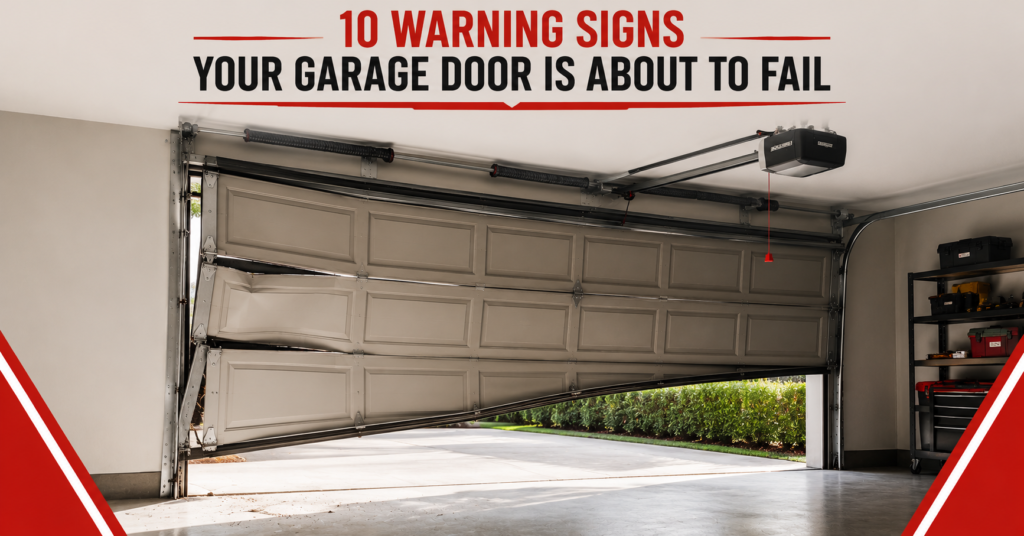
If your door hesitates, jerks, or moves in stages instead of one smooth motion, the springs are likely losing tension or the opener’s motor is struggling. This is one of the earliest signs of garage door spring wear and is easy to miss because the door still technically works.
3. The Door Won’t Open or Close Fully
A door that stops halfway or reverses before touching the floor usually has a sensor, track, or spring problem. Modern openers have safety sensors that stop the door if they detect an obstruction, but if nothing is blocking the path, it’s a sign of a mechanical fault that needs a professional look.
4. Visible Sagging or Uneven Movement
Stand outside and watch your door open. If one side moves faster than the other, or the door looks crooked when closed, you likely have an unbalanced door caused by an unequal spring or a cable issue. An unbalanced door puts uneven pressure on the opener and can shorten its lifespan significantly.
5. Worn, Frayed, or Rusted Cables
Lift cables carry an enormous amount of tension. Frayed strands, visible rust, or cables that look loose are a serious red flag. A snapped cable can cause the door to fall suddenly, so this is not a DIY fix, it needs immediate professional garage door repair.
6. Rusted, Stretched, or Broken Springs
Springs are the workhorse of your garage door system, and they wear out over time even with normal use. Look for gaps between coils, rust, or visible stretching. If you hear a loud bang from the garage, that’s often a spring snapping. Garage door spring replacement is one of the most common repairs homeowners eventually need, and catching it early prevents the door from becoming completely inoperable.
7. The Door Feels Heavy When Lifted Manually
Disconnect the opener and try lifting the door by hand (with help, and carefully). It should feel relatively light and balanced. If it feels heavy or drops suddenly, your springs aren’t doing their job anymore. This simple balance test is something our technicians do during every maintenance visit.
8. The Opener Struggles, Reverses, or Runs Constantly
If your garage door opener strains, makes a humming sound without moving the door, or reverses unexpectedly, the motor may be compensating for worn springs or cables, or the opener itself could be nearing the end of its life. Constant strain shortens the opener’s lifespan and can lead to a complete failure at the worst possible time.
9. Excessive Shaking or Vibration
Some vibration is normal, but excessive shaking, wobbling, or rattling during operation usually points to loose hardware, worn rollers, or a bent track. Left unaddressed, this can cause the door to derail entirely.
10. Gaps, Drafts, and Rising Energy Bills
A garage door that no longer seals properly against the floor lets in cold air, moisture, and pests. Worn weatherstripping or a warped panel are common culprits. Beyond comfort, this can raise your heating and cooling costs, especially if your garage is attached to your home.
Common Mistakes Homeowners Make
Even well-intentioned homeowners often make these mistakes when their garage door starts acting up:
- Ignoring small noises. A squeak today can become a snapped spring next week.
- Attempting DIY spring replacement. Torsion springs are under extreme tension and have caused serious injuries. This is a job for trained technicians.
- Using the wrong lubricant. WD-40 attracts dust and isn’t a substitute for proper garage door lubricant on rollers, hinges, and tracks.
- Skipping annual maintenance. Many failures happen simply because the door was never professionally inspected.
- Continuing to use a door that’s off-balance. This accelerates wear on the opener and every other component.
Expert Tips to Prevent Garage Door Failure
- Do a monthly visual inspection. Look for rust, fraying, gaps, or misalignment.
- Test the auto-reverse safety feature. Place a block of wood in the door’s path; it should reverse on contact.
- Lubricate moving parts twice a year using a silicone-based garage door lubricant.
- Tighten loose hardware like hinges and roller brackets as part of routine upkeep.
- Schedule professional maintenance annually. A trained technician can catch wear on springs, cables, and tracks long before they fail.
When to Call a Professional vs. When It’s Safe to DIY
Cleaning tracks, tightening visible bolts, and lubricating hinges are safe homeowner tasks. But anything involving springs, cables, or the opener’s internal wiring should always go to a licensed technician. The tension stored in a garage door spring can cause severe injury if handled incorrectly, and a botched repair often costs more to fix than the original problem.
Serving Homeowners Across the Chicagoland Area
Alba Garage Doors provides residential and commercial garage door repair, spring replacement, and opener installation throughout the region, including Elgin, Schaumburg, Palatine, Hoffman Estates, Buffalo Grove, Carpentersville, Bartlett, Streamwood, Algonquin, Cary, Lake in the Hills, and Woodstock, along with the surrounding communities. Our technicians are available for same-day and emergency service, so a failing door never has to wait until it becomes a bigger problem.
Frequently Asked Questions
How long does a garage door spring usually last?
Most torsion springs are rated for 10,000 to 15,000 cycles, roughly 7 to 10 years of normal use, depending on how often the door is used.
Is it dangerous to keep using a garage door that’s making noise?
Noise alone isn’t always dangerous, but it’s a warning sign. Continuing to use a door with grinding, popping, or jerky movement increases the risk of a sudden failure.
Can I replace a garage door spring myself?
It’s strongly discouraged. Springs are under high tension and require special tools and training to replace safely.
How often should I get my garage door professionally inspected?
Once a year is recommended for most homes, or more often for doors used multiple times a day.
Why is my garage door opener working harder than usual?
This usually means the springs are losing tension or the door is out of balance, forcing the motor to do extra work.
What’s the average cost to repair a failing garage door?
Costs vary depending on the issue, spring replacement, cable repair, or opener service each have different price ranges. A technician can give an accurate quote after inspecting the door.
Contact Alba Garage Doors
If your garage door is making unusual noises, struggling to open, or needs professional repair or replacement, the team at Alba Garage Doors is here to help. We provide trusted garage door repair, garage door spring replacement, garage door opener repair, emergency garage door service, and garage door installation throughout Illinois.
Our experienced technicians proudly serve homeowners in Cary, Lake in the Hills, Algonquin, Schaumburg, Elgin, Libertyville, McHenry, Woodstock, Round Lake, Fox Lake, Antioch, Vernon Hills, Barrington, and many surrounding communities.
Call us today for fast and reliable garage door service.
Phone: (847) 596-0902
Website: www.albagaragedoors.com
Final Thoughts
A garage door rarely fails out of nowhere. It gives you signs first: noise, hesitation, sagging, or a heavier-than-usual lift. Catching these warning signs early is the simplest way to avoid a stuck door, an unexpected repair bill, or a safety hazard in your driveway.
If you’ve noticed any of these signs, don’t wait for a complete breakdown. Reach out to Alba Garage Doors for a professional inspection, and let our technicians make sure your garage door is safe, balanced, and ready for years of reliable use.
Summary
A failing garage door usually shows warning signs like loud grinding noises, jerky movement, sagging, frayed cables, or a heavy manual lift before it stops working completely. Watch for these ten signs, address them early, and schedule professional garage door repair or spring replacement to avoid costly damage or injury.