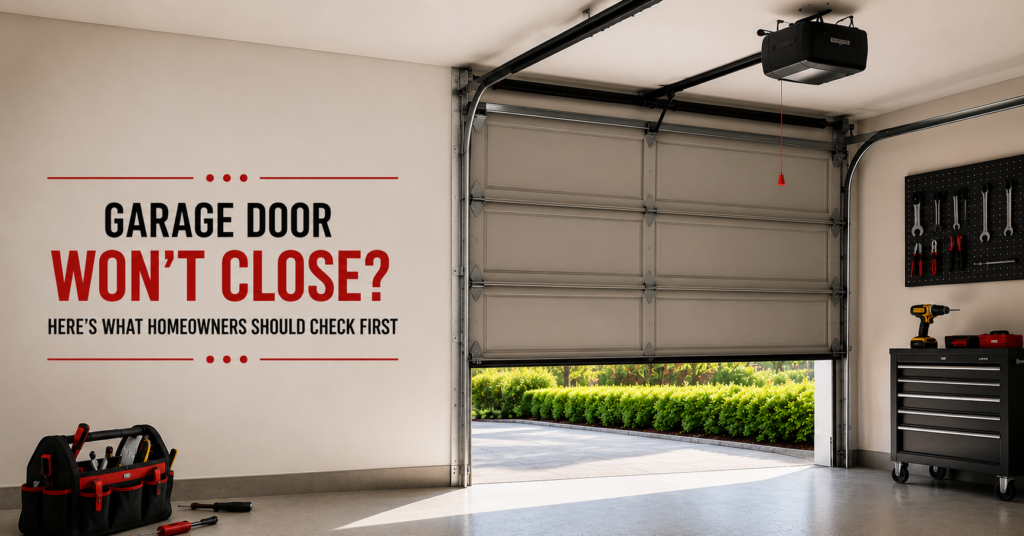
You hit the button, the door starts down, and then it stops. Or worse, it goes down and immediately reverses back up. It’s one of the most common calls we get, and the good news is that a garage door that won’t close doesn’t always mean something is broken. Often it’s a small, fixable issue you can check yourself in under ten minutes.
Before you assume the worst or reach for a wrench near the springs (please don’t), work through this checklist. It covers the most common reasons a garage door refuses to close, in the order you should check them, and tells you exactly when it’s time to stop troubleshooting and call a professional.
Why Won’t My Garage Door Close? Common Causes at a Glance
Most “won’t close” problems come down to one of these:
- Blocked or dirty safety sensors
- Something in the door’s path
- Debris or misalignment in the tracks
- A dead remote battery or opener issue
- Close-limit settings that need adjusting
- A broken spring or cable
- The manual lock engaged
- Ice or frost on the tracks in cold weather
Let’s walk through each one.
8 Things to Check Before Calling a Professional
1. Check the Safety Sensors First
This is the number one cause of a garage door that won’t close. Every modern garage door has two photo-eye sensors near the bottom of the tracks, about six inches off the ground, that shoot an invisible beam across the doorway. If that beam is blocked, dirty, or the sensors are knocked out of alignment, the door will refuse to close or reverse immediately.
What to check:
- Make sure nothing (a bike, a leaf, a stray box) is sitting in the sensor’s path.
- Wipe both lenses clean with a soft cloth.
- Look at the small indicator lights on each sensor. If one is blinking or off instead of solid, the sensors are misaligned and need to be adjusted so they face each other directly.
2. Look for Obstructions in the Door’s Path
It sounds obvious, but it’s easy to miss. Toys, garden tools, or even a buildup of leaves can trigger the auto-reverse safety feature. Walk the full width of the door’s travel path and clear anything in the way.
3. Inspect the Tracks for Debris or Misalignment
Dirt, rust, or small objects lodged in the metal tracks can stop the rollers from moving smoothly, causing the door to stall or reverse. While you’re there, check whether the tracks are bent or pulled away from the wall. A misaligned track is a mechanical issue, not something to force back into place yourself.
4. Test the Remote, Keypad, and Wall Switch
Sometimes the fix really is that simple. Try a different remote or the wall-mounted switch. If neither responds, replace the remote batteries. If the wall switch works but the remote doesn’t, the issue is likely the remote itself or its programming, not the door.
5. Check the Opener’s Close-Limit Settings
Garage door openers have a limit setting that tells the motor exactly how far down to travel before stopping. If this limit is set incorrectly, the door may stop short of the floor and appear to be malfunctioning. Most openers have a small adjustment screw or digital menu for this. If you’re not familiar with your opener model, this is a quick fix for a technician rather than something to guess at.
6. Look at the Springs and Cables
If the door won’t budge at all, or it moves partway down and then stalls under its own weight, a broken spring or a snapped cable is a likely culprit. You may notice the door looks crooked, or you’ll hear a loud bang from the garage before the problem started. Springs and cables are under significant tension and should only be handled by a trained technician. This is one of the most common reasons homeowners eventually need garage door spring replacement.
7. Make Sure the Manual Lock Isn’t Engaged
Many garage doors have a manual lock lever on the inside, usually used when you’re away for an extended time. If it’s accidentally engaged, the door will physically resist closing even though the opener seems to be working fine. Check for a small sliding lock near the bottom panel.
8. Check for Ice, Frost, or Frozen Tracks
If you’re dealing with this in the middle of a Chicagoland winter, don’t overlook the cold. Ice buildup on the tracks, a frozen bottom seal stuck to the concrete, or condensation freezing on the rollers can all stop a garage door from closing properly. Never force a frozen door with the opener, as this can strip the gears or bend the track. Gently clear visible ice and try again once things thaw.
When a “Won’t Close” Door Signals a Bigger Problem
If you’ve worked through the checklist above and the door still won’t close, it’s likely one of these underlying issues:
- A broken torsion or extension spring
- A worn-out opener motor or logic board
- A bent or damaged track
- Frayed or snapped lift cables
- A door that’s come off its rollers
None of these are homeowner-fix situations. Continuing to force the door with the opener can cause more damage and creates a real safety risk.
Common Mistakes Homeowners Make
- Forcing the door manually or repeatedly hitting the remote. This can strip opener gears or worsen a spring issue.
- Ignoring the sensor lights. A blinking sensor light is diagnostic information, not something to dismiss.
- Assuming it’s always the opener. Many “opener” problems are actually sensor, track, or spring issues.
- DIY spring or cable repair. This is one of the most dangerous home repairs due to stored tension.
- Skipping the manual lock check. It’s a five-second fix that gets overlooked constantly.
Expert Tips to Prevent This From Happening Again
- Clean and check sensor alignment every few months.
- Keep the door’s path and tracks free of clutter and debris.
- Lubricate rollers, hinges, and tracks twice a year with a silicone-based lubricant.
- Have your garage door professionally inspected annually, especially before winter.
- Test the auto-reverse safety feature regularly with a block of wood in the door’s path.
When to Call a Professional vs. DIY
Sensor cleaning, clearing obstructions, and swapping remote batteries are safe for any homeowner. But springs, cables, bent tracks, and opener motor issues should always go to a licensed technician. What looks like a simple fix can quickly become an expensive one if the underlying mechanical issue is misdiagnosed.
Serving Homeowners Across the Chicagoland Area
Alba Garage Doors provides same-day and emergency garage door repair throughout the region, including Elgin, Schaumburg, Palatine, Hoffman Estates, Buffalo Grove, Algonquin, Cary, Lake in the Hills, Carpentersville, Barrington, Woodstock, and the surrounding communities. If your garage door won’t close and the checklist above hasn’t solved it, our technicians can diagnose and repair the issue quickly, often the same day you call.
Frequently Asked Questions
Why does my garage door start closing and then reverse back up?
This is almost always the safety sensors detecting an obstruction, or being misaligned or dirty. Check both sensor lenses and their alignment first.
Can cold weather really stop a garage door from closing?
Yes. Ice on the tracks, a frozen bottom seal, or stiff lubricant in freezing temperatures can all prevent smooth operation, especially common during Midwest winters.
Is it safe to manually close a garage door that won’t close with the opener?
Only if you’ve confirmed it’s not a spring or cable issue. If the door feels unusually heavy or uneven, stop and call a professional.
How do I know if it’s the sensors or the opener itself?
If the wall switch also fails to close the door, and the sensor lights aren’t solid, it’s likely a sensor issue. If sensors look fine but nothing responds at all, the opener itself may need service.
How much does it cost to fix a garage door that won’t close?
It depends on the cause. Sensor realignment is often a quick, low-cost fix, while spring replacement or opener motor repair costs more. A technician can give you an accurate quote after inspection.
Contact Alba Garage Doors
If your garage door is making unusual noises, struggling to open, or needs professional repair or replacement, the team at Alba Garage Doors is here to help. We provide trusted garage door repair, garage door spring replacement, garage door opener repair, emergency garage door service, and garage door installation throughout Illinois.
Our experienced technicians proudly serve homeowners in Cary, Lake in the Hills, Algonquin, Schaumburg, Elgin, Libertyville, McHenry, Woodstock, Round Lake, Fox Lake, Antioch, Vernon Hills, Barrington, and many surrounding communities.
Call us today for fast and reliable garage door service.
Phone: (847) 596-0902
Website: www.albagaragedoors.com
Final Thoughts
A garage door that won’t close is frustrating, but it’s rarely a mystery. Most of the time, the cause is something simple: a dirty sensor, an object in the way, or a setting that’s slightly off. Working through this checklist will solve the problem in many cases, and if it doesn’t, you’ll at least know exactly what to tell your technician.
If your garage door still won’t close after checking these eight things, don’t keep forcing it. Contact Alba Garage Doors for a fast, professional diagnosis, and get your door back to closing safely and reliably.
Summary
A garage door that won’t close is usually caused by blocked or misaligned safety sensors, an obstruction in its path, dirty tracks, a dead remote, incorrect limit settings, or a broken spring. Check sensors and the door’s path first, then call a professional garage door repair technician if the issue persists.