Garage door lifespan isn’t really one number. It’s a handful of different parts, each wearing out on its own timeline, working together until one of them finally gives out first. Springs, rollers, and cables all carry a different kind of stress, which means they all age differently too.
If you’ve ever wondered whether a part is failing early or right on schedule, this breaks down what a normal lifespan actually looks like for each one and what tends to speed up or slow down that timeline.
At Alba Garage Doors, this is one of the questions we get asked constantly, usually right after a homeowner notices a new noise or a part that looks more worn than expected. Here’s what the real numbers look like and why two doors of the same age can be at completely different points in their lifespan.
Quick Reference: Average Garage Door Part Lifespan
| Part | Typical Lifespan | How It Usually Fails |
|---|---|---|
| Springs | 7–10 years | Suddenly, often with a loud bang |
| Rollers | 7–10 years | Gradually, with noise and wobbling first |
| Cables | 8–12 years | Gradually, with visible fraying first |
Why Garage Door Lifespan Isn’t the Same for Every Part
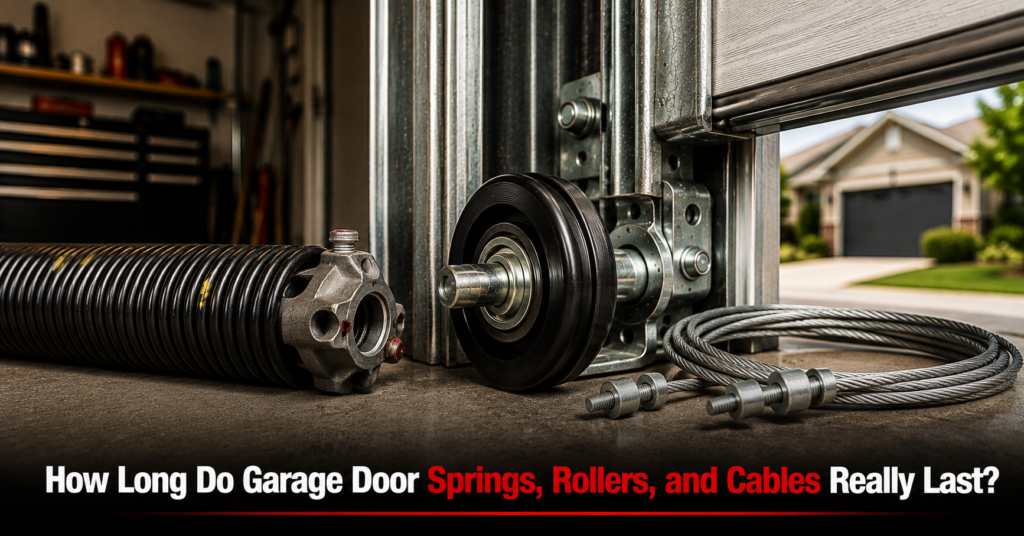
A garage door isn’t a single component. It’s a system, and each part inside that system handles a different kind of work. Springs manage weight and tension. Cables guide the lift. Rollers handle constant motion and friction. Because the job is different for each one, so is the wear.
How Long Do Garage Door Springs Last?
Most torsion springs are rated for 10,000 to 15,000 open-and-close cycles, which usually works out to about 7 to 10 years for an average household. Homes that use the garage door more often, like a daily main entrance, tend to reach that number sooner. Springs don’t typically wear down gradually either. They tend to fail suddenly, often with a loud bang, once they’ve reached the end of their cycle count.
How Long Do Garage Door Rollers Last?
Rollers generally last 7 to 10 years as well, though the material matters. Steel rollers are durable but can rust over time, especially with road salt exposure in colder months. Nylon rollers run quieter and resist rust, but the material itself gradually wears down with age. Unlike springs, rollers tend to fail slowly, giving off warning signs like noise or wobbling well before they stop working entirely.
How Long Do Garage Door Cables Last?
Cables typically last 8 to 12 years under normal conditions. Since they work alongside the springs, cable wear often mirrors spring wear, though cables are more likely to show visible warning signs first, like fraying or looseness, before they fail.
What Affects Garage Door Lifespan the Most?
Usage Frequency
A door that opens and closes multiple times a day will naturally reach the end of a part’s cycle count faster than one used once or twice.
Climate and Weather Exposure
Cold winters, humidity, and road salt all accelerate wear, particularly on cables and steel rollers. Homes in colder regions often see shorter lifespans than the general averages suggest.
Maintenance Habits
Regular lubrication and prompt attention to small issues can meaningfully extend how long these parts last. Neglected parts wear out faster, sometimes significantly so.
Quality of the Original Parts
Higher-quality springs, rollers, and cables tend to outlast budget alternatives, even under the same conditions and usage patterns.
Signs Each Part Is Nearing the End of Its Lifespan
Springs
A loud bang, a door that suddenly feels too heavy, or visible gaps between coils are all signs that a spring is failing or close to it.
Rollers
Grinding or squealing noises, visible wobbling, or cracked and flat-spotted rollers all point to rollers nearing the end of their usable life.
Cables
Fraying strands, visible rust, or a cable that looks loose or slack are signs it should be replaced soon, ideally before it fails completely.
Should You Replace These Parts Together or Separately?
If one spring has failed, it’s usually worth replacing both, since the older one is likely close behind. The same logic often applies to rollers, since they tend to wear at a similar rate across the full set. Cables are typically replaced in pairs as well, for the same reason.
How to Extend the Lifespan of Your Garage Door Parts
- Lubricate springs, rollers, and hinges twice a year with a silicone-based lubricant.
- Keep tracks clean and free of dirt or debris.
- Address noise or hesitation early, rather than waiting for a full failure.
- Schedule a professional inspection annually to catch wear before it becomes obvious.
- Avoid overusing the door for tasks it wasn’t intended for, like propping it partially open for long periods.
- Wipe down cables and springs after winter to remove road salt residue before it causes rust.
- Keep an eye on how many times the door cycles daily. A door used far more than average will naturally reach the end of a part’s lifespan sooner than these general estimates suggest.
When to Call a Professional
Cleaning and lubrication are fine for most homeowners to handle. But replacing springs, cables, or rollers involves the door’s tensioned system and should always be done by a trained technician. Attempting these repairs without the right tools or training carries a real safety risk.
Frequently Asked Questions
Do garage door springs really only last a few years?
Most torsion springs last 7 to 10 years under normal use, though homes that use the door more frequently may see that number sooner.
Why do springs fail suddenly instead of gradually?
Springs wear down internally with each cycle, but the failure itself tends to happen all at once, once the metal has reached its limit, which is why it often comes with a loud bang.
Are nylon rollers really better than steel ones?
Nylon rollers run quieter and resist rust, making them a popular upgrade, though steel rollers can still be a durable, budget-friendly option for many homes.
Can I extend my garage door parts’ lifespan with regular maintenance?
Yes. Lubrication, prompt repairs, and annual inspections can meaningfully extend how long springs, rollers, and cables last compared to a neglected system.
Should I replace all three parts, springs, rollers, and cables, at the same time?
Not necessarily, unless they’re all nearing the end of their expected lifespan together. A professional inspection can tell you which parts actually need attention now.
Contact Alba Garage Doors
If your garage door is making unusual noises, struggling to open, or needs professional repair or replacement, the team at Alba Garage Doors is here to help. We provide trusted garage door repair, garage door spring replacement, garage door opener repair, emergency garage door service, and garage door installation throughout Illinois.
Our experienced technicians proudly serve homeowners in Cary, Lake in the Hills, Algonquin, Schaumburg, Elgin, Libertyville, McHenry, Woodstock, Round Lake, Fox Lake, Antioch, Vernon Hills, Barrington, and many surrounding communities.
Call us today for fast and reliable garage door service.
Phone: (847) 596-0902
Website: www.albagaragedoors.com
Final Thoughts
Garage door lifespan really comes down to a handful of parts, each aging at its own pace. Springs tend to fail suddenly after years of steady wear, rollers wear down gradually with plenty of warning, and cables usually show visible signs before they give out. Knowing what’s normal for each one makes it a lot easier to catch a problem before it becomes an emergency.
If a part on your garage door seems like it might be nearing the end of its life, don’t wait for it to fail completely. Reach out to Alba Garage Doors for an inspection and find out exactly where things stand.
Summary
Garage door springs typically last 7 to 10 years, rollers last 7 to 10 years, and cables last 8 to 12 years, depending on usage and climate. Springs tend to fail suddenly, while rollers and cables show warning signs first. Regular maintenance and a professional garage door repair inspection help extend their lifespan.