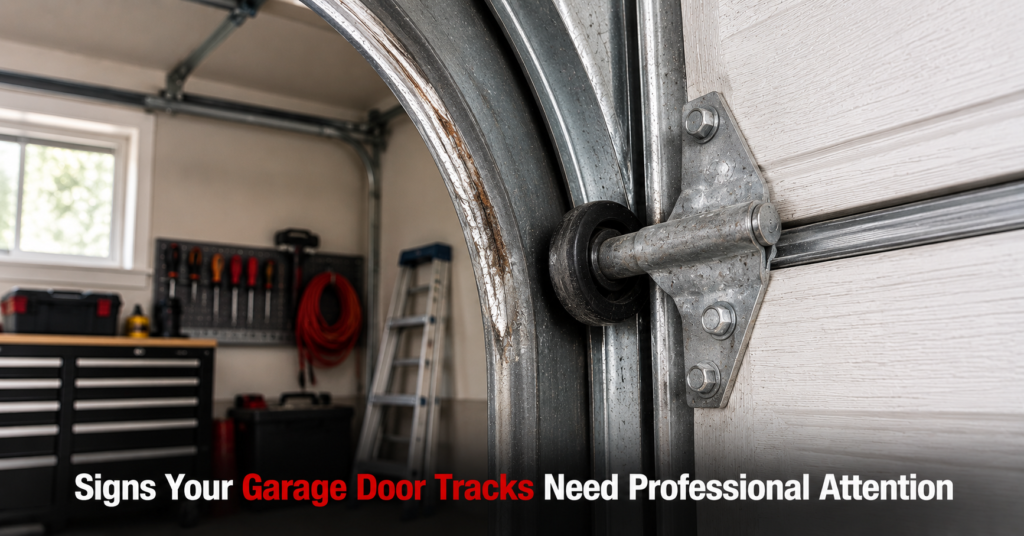
Garage door tracks don’t get much attention until something feels off. They quietly guide the door up and down every single day, and most homeowners never think about them until a noise, a gap, or a stuck door forces the issue.
The tricky part is that track problems can look like a lot of other things. A door that seems crooked or noisy might actually be a track issue in disguise. Here’s how to recognize the real signs, and when it’s time to stop troubleshooting and call in a professional.
At Alba Garage Doors, tracks are one of the first things our technicians check, since so many other symptoms homeowners describe actually trace back to this one part.
What Do Garage Door Tracks Actually Do?
The metal tracks on either side of your garage door guide the rollers as the door travels up, curves, and settles into an open position along the ceiling. They need to stay straight, evenly spaced, and securely mounted for the door to move the way it’s designed to.
Signs Your Garage Door Tracks Need Professional Attention
1. Visible Gaps Between the Rollers and the Track
Look closely at where the rollers sit inside the track. A visible gap or a roller that looks like it’s barely holding on is a sign the track has shifted out of its proper position.
2. Bent or Dented Sections
A bump from a car, a stray tool, or even routine wear over time can leave a track slightly bent. Even a small dent can catch the rollers and disrupt smooth movement.
3. Rust or Corrosion Buildup
Rust weakens the metal and can also create rough spots that increase friction as the rollers pass over them. This is more common in areas exposed to road salt or excess moisture.
4. The Door Rubs or Scrapes During Movement
A scraping sound during operation is often the track making contact with a roller or panel edge that shouldn’t be touching it, a sign the alignment has shifted.
5. One Side Moves Differently Than the Other
If one side of the door visibly lags, jumps ahead, or moves at a different pace than the other, the tracks on each side may no longer be perfectly parallel.
6. Loose or Missing Mounting Brackets
Tracks are secured to the wall with brackets that can loosen over time. A loose bracket allows the track to shift slightly with every cycle, gradually making the problem worse.
7. The Door Has Come Off the Track Before
If your garage door has ever come off its track, even briefly, there’s a good chance the track itself sustained some damage in the process, even if the door was put back without issue.
8. Excessive Noise Concentrated at One Section
Noise that happens consistently at the same point in the door’s cycle usually points to a specific spot on the track, rather than a broader mechanical issue.
What Causes Garage Door Track Damage?
Track problems typically develop from one of a few common sources:
- Accidental impacts from vehicles, bikes, or stored items
- Loose hardware that lets the track shift gradually
- Age and general wear after years of daily use
- Rust from moisture or road salt exposure
- A door that’s come off track and been reset without a full inspection
Quick Reference: Track Symptom vs. Likely Cause
| What You Notice | Likely Cause |
|---|---|
| Gap between roller and track | Track has shifted from its mounting |
| Scraping sound during movement | Bent section or misalignment |
| Rust along the metal | Moisture or road salt exposure |
| One side moves unevenly | Tracks no longer parallel |
| Door has slipped off before | Possible hidden bend or bracket damage |
Is It Safe to Use a Door With Damaged Tracks?
For minor issues, usually yes in the short term, but it’s not something to ignore. Damaged tracks put uneven strain on rollers, hinges, and the opener, and that strain tends to accelerate wear across the whole system. In more serious cases, a badly bent or misaligned track increases the risk of the door coming off entirely.
DIY Track Cleaning vs. Professional Track Repair
Cleaning dirt and debris out of the tracks is a simple, safe task for most homeowners. But adjusting, straightening, or replacing a track involves working near a spring-tensioned system, and getting the alignment wrong can create a bigger safety issue than the one you started with. This part of the repair should always go to a trained technician.
How to Prevent Track Damage
- Keep the garage free of clutter that could bump into the tracks.
- Check mounting brackets periodically for looseness.
- Clean tracks regularly to prevent dirt and rust buildup.
- Address small noises or hesitation early, before they signal a bigger issue.
- Have a professional inspect the tracks after any incident involving the door coming off its path.
When to Call a Professional
If you notice gaps, bends, rust, uneven movement, or a door that’s come off track before, it’s time for a professional inspection. A technician can determine whether the track needs cleaning, adjustment, or full replacement, and correct it before it leads to a bigger repair.
Serving Homeowners in Elgin, Schaumburg, Algonquin, and Cary
Homeowners across Elgin, Schaumburg, Algonquin, and Cary regularly call in about a noise or a slightly crooked door that turns out to be a track issue. In most cases, a same-day inspection identifies the exact cause and gets the door back to moving safely and smoothly.
Frequently Asked Questions
How do I know if my garage door problem is the track and not the spring?
Track issues often show up as noise, scraping, or uneven movement concentrated at one section, while spring issues tend to affect the door’s overall weight and balance.
Can I straighten a bent garage door track myself?
It’s not recommended. Tracks are part of a system under spring tension, and improper adjustment can create a serious safety risk.
Is rust on garage door tracks a serious problem?
It can become one over time. Rust weakens the metal and creates friction, which is worth addressing before it leads to more significant damage.
What should I do if my garage door has come off the track before?
Even if the door was reset without an obvious issue, it’s worth having the track professionally inspected, since hidden damage from the incident may still be present.
How often should garage door tracks be inspected?
Once a year is a good baseline, or sooner if you’ve noticed any new noise, scraping, or uneven movement.
Contact Alba Garage Doors
If your garage door is making unusual noises, struggling to open, or needs professional repair or replacement, the team at Alba Garage Doors is here to help. We provide trusted garage door repair, garage door spring replacement, garage door opener repair, emergency garage door service, and garage door installation throughout Illinois.
Our experienced technicians proudly serve homeowners in Cary, Lake in the Hills, Algonquin, Schaumburg, Elgin, Libertyville, McHenry, Woodstock, Round Lake, Fox Lake, Antioch, Vernon Hills, Barrington, and many surrounding communities.
Call us today for fast and reliable garage door service.
Phone: (847) 596-0902
Website: www.albagaragedoors.com
Final Thoughts
Garage door tracks rarely announce a problem loudly. Instead, it’s a gap, a scrape, or a slightly uneven movement that builds gradually until it’s hard to ignore. Catching these signs early, and knowing when to bring in a professional instead of guessing, keeps the fix simple and protects the rest of the door’s moving parts.
If any of these signs sound familiar, don’t wait for the door to come off track entirely. Reach out to Alba Garage Doors for an inspection, and get your tracks back in proper working order.
Summary
Signs your garage door tracks need professional attention include visible gaps at the rollers, bent or rusted sections, scraping noises, and uneven movement between the two sides. Damaged tracks strain the rest of the door system and should be inspected by a professional garage door repair technician before the issue worsens.