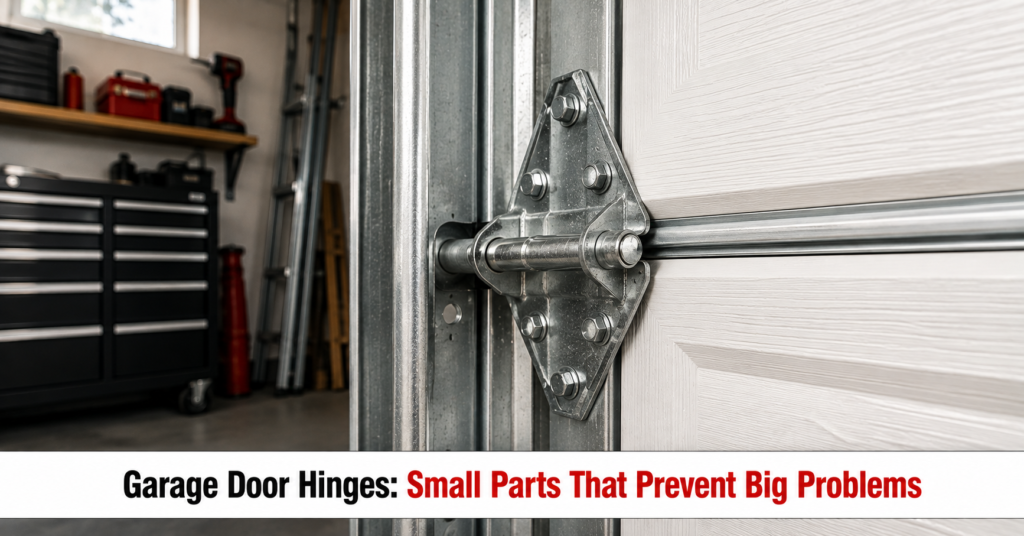
Garage door hinges rarely get mentioned in the same breath as springs or openers, but they’re doing constant work every single time your door moves. They’re small, inexpensive, and easy to forget about, right up until one of them starts causing a problem that’s much bigger than its size would suggest.
If you’ve never given much thought to the hinges on your garage door, this is worth a few minutes. Here’s what they actually do, how to tell when they’re wearing out, and why catching a hinge issue early can save you from a much larger repair later.
At Alba Garage Doors, hinge wear is one of those issues that often gets misdiagnosed as a spring or track problem, when it’s really the small joint holding two panels together that’s actually at fault.
What Do Garage Door Hinges Actually Do?
Garage doors are made of several panels connected by hinges, which allow the door to bend as it curves along the track and flattens out when fully open. Every time the door cycles, these joints absorb the motion and stress of the panels folding and unfolding together.
Why Garage Door Hinges Matter More Than They Get Credit For
1. They Allow the Door to Fold and Travel Smoothly
Without functioning hinges, a sectional door couldn’t curve along the track the way it’s designed to. They’re what make the folding motion possible in the first place.
2. They Keep Panels Properly Aligned
Hinges hold panels in position relative to each other. When one weakens or loosens, the panels it connects can shift slightly, throwing off the door’s overall alignment.
3. They Absorb Repeated Stress With Every Cycle
Every open-and-close cycle puts mechanical stress on each hinge. Over thousands of cycles, that repeated stress is exactly what leads to eventual wear, even on well-made hardware.
4. A Single Failing Hinge Can Affect the Whole Door
Because panels are all connected, one damaged hinge can affect how the sections above and below it move, sometimes creating problems that look like they’re coming from somewhere else entirely.
Signs Your Garage Door Hinges Are Wearing Out
Squeaking or Grinding at Panel Joints
A high-pitched squeak or grinding sound coming specifically from where two panels meet is one of the clearest signs a hinge needs lubrication or replacement.
Visible Rust or Cracks
Rust weakens the metal over time, and cracks can develop with enough cycles, especially on older or lower-quality hardware. Either should be addressed before the hinge fails completely.
Sagging or Misaligned Panels
If one section of the door looks slightly out of position compared to the rest, a worn hinge at that joint is a common cause.
Increased Vibration During Operation
Loose or worn hinges often create a noticeable rattle or shake at that specific point in the door as it moves.
Types of Garage Door Hinges
Standard Steel Hinges
The most common type, standard steel hinges are durable and work well for most residential doors under normal use.
Heavy-Duty Hinges
Built for larger or heavier doors, heavy-duty hinges are designed to handle more stress and are often used on doors with added insulation or thicker panels.
Hinges by Position
Garage door hinges are typically numbered based on their position on the door, since hinges closer to the bottom or top handle different amounts of stress than those in the middle. This is why replacing the correct hinge type for each position matters more than it might seem.
What Happens If Worn Hinges Are Ignored?
A single worn hinge rarely causes an immediate failure, but it does put extra strain on the hinges around it as they compensate. Left long enough, this can lead to a cracked panel, a door that binds or catches during operation, or a section that comes loose from the track entirely.
How to Maintain Garage Door Hinges
- Lubricate hinges twice a year with a silicone-based lubricant.
- Check for rust or visible cracks during routine inspections.
- Tighten any loose mounting screws as part of regular maintenance.
- Address squeaking or grinding sounds promptly rather than waiting.
- Replace hinges in the correct position type rather than using a generic substitute.
Common Mistakes Homeowners Make
- Ignoring a squeak because the door still works. A small noise is often the earliest and easiest sign to catch.
- Assuming it’s always a spring issue. Panel misalignment is just as often a hinge problem.
- Using the wrong hinge type during a repair. Hinge position affects the amount of stress it needs to handle.
- Skipping lubrication on hinges specifically. Many homeowners lubricate rollers but forget the hinges nearby.
- Waiting until a panel visibly sags. Early replacement is simpler than repairing damage caused by a long-ignored hinge.
When to Call a Professional
Lubricating hinges and checking for visible rust are safe tasks for most homeowners. Actual hinge replacement, especially near the top or bottom of the door where stress is highest, should go to a trained technician to ensure the door stays properly balanced and aligned.
Frequently Asked Questions
How do I know if it’s a hinge problem and not a spring problem?
Hinge issues usually show up as a squeak or misalignment at a specific panel joint, while spring problems tend to affect the door’s overall weight and balance.
Can a broken hinge cause my garage door to stop working?
It’s possible in more advanced cases, especially if a panel becomes loose enough to bind in the track. Most hinge issues start smaller, with noise or minor misalignment.
How often should garage door hinges be replaced?
There’s no fixed timeline, but hinges showing rust, cracks, or consistent noise should be replaced as soon as it’s noticed rather than left to worsen.
Are all garage door hinges the same?
No. Hinges are typically positioned by number based on where they sit on the door, since different positions handle different amounts of stress.
Can I lubricate garage door hinges myself?
Yes. Lubricating hinges with a silicone-based spray is a simple, safe task for most homeowners as part of routine maintenance.
Contact Alba Garage Doors
If your garage door is making unusual noises, struggling to open, or needs professional repair or replacement, the team at Alba Garage Doors is here to help. We provide trusted garage door repair, garage door spring replacement, garage door opener repair, emergency garage door service, and garage door installation throughout Illinois.
Our experienced technicians proudly serve homeowners in Cary, Lake in the Hills, Algonquin, Schaumburg, Elgin, Libertyville, McHenry, Woodstock, Round Lake, Fox Lake, Antioch, Vernon Hills, Barrington, and many surrounding communities.
Call us today for fast and reliable garage door service.
Phone: (847) 596-0902
Website: www.albagaragedoors.com
Final Thoughts
Garage door hinges may be small, but they carry more responsibility than most homeowners give them credit for. They keep panels aligned, absorb constant stress, and quietly hold the whole folding motion together. Catching wear early — a squeak, a bit of rust, a slightly off panel — is a simple way to avoid a much bigger repair down the line.
If you’ve noticed anything unusual at a panel joint, don’t wait for it to get worse. Reach out to Alba Garage Doors for an inspection, and keep those small parts from turning into a big problem.
Summary
Garage door hinges connect the panels and allow the door to fold smoothly along the track. Worn hinges cause squeaking, rust, panel misalignment, and vibration, and can strain nearby hardware if ignored. Regular lubrication and prompt replacement by a professional garage door repair technician prevent bigger structural issues.